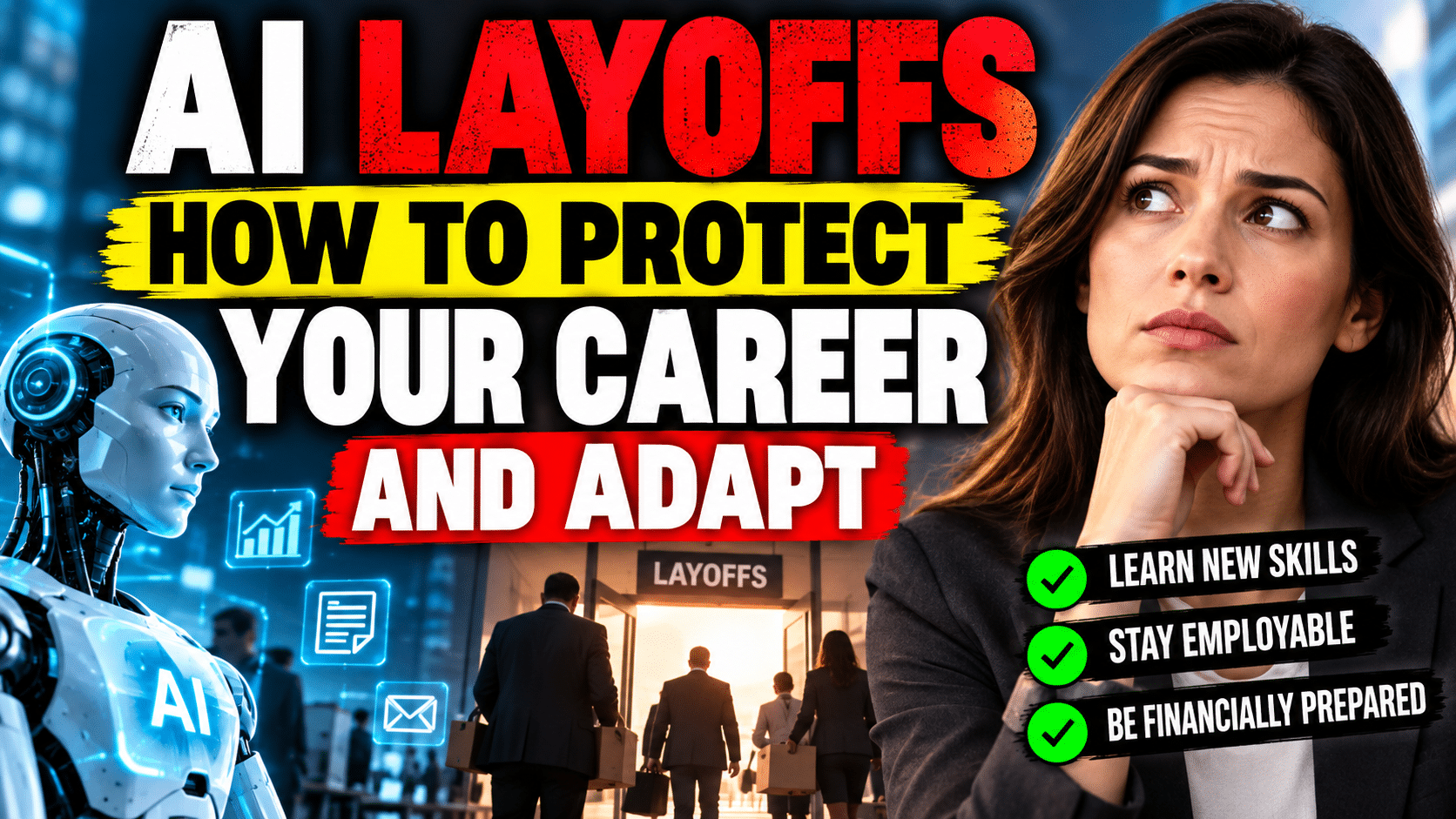
AI Layoffs: How to Protect Your Career and Adapt
A company can invest heavily in artificial intelligence while reducing costs and restructuring its workforce. For employees, that raises a difficult question: is a job becoming less necessary, or is the employer changing how the work gets done?
For a marketer, financial analyst, project manager, software developer, or administrative professional, the answer may not be obvious. AI can draft reports, summarize documents, analyze information, generate code, and assist with customer service. These capabilities can change the amount of time required for certain tasks and influence how companies organize teams.
But AI exposure does not automatically mean a job will disappear. Career resilience after AI layoffs starts with understanding that distinction, identifying how your responsibilities may change, and preparing for employment uncertainty without assuming the worst outcome is inevitable.
Research from the International Labour Organization (ILO) indicates that generative AI is more likely to transform many existing jobs than make entire occupations redundant. The effects depend on the tasks involved, the technology’s capabilities, and how employers implement it. Read the ILO’s 2025 research brief.
For U.S. workers, the stakes extend beyond a job title. Employment may determine household income, health insurance, retirement contributions, and the ability to meet monthly expenses. Preparing for workplace change is therefore both a career decision and a financial one.
The goal is not to predict exactly which jobs will survive. It is to understand which responsibilities are changing, where human judgment remains useful, and how to build professional options before a disruption forces a decision.
How AI Layoffs Affect White-Collar Jobs
AI layoffs and white-collar job changes are related, but they are not the same thing. A layoff is an employment decision; automation is a technological capability. Employers may use AI to reduce labor requirements, increase output, improve service, or allow existing employees to focus on different responsibilities.
The distinction matters because companies can adopt the same technology and make different staffing decisions. One employer may reduce hiring, another may reorganize a department, and another may use AI to expand what its existing team can accomplish.
Which tasks are most exposed to AI automation?
Tasks involving repeatable digital inputs and outputs may be easier to automate than work requiring complex physical activity, interpersonal judgment, or decisions in unpredictable situations. However, task exposure alone cannot determine whether an employer will eliminate a position.
| Work category | Potential AI application | Human responsibilities that may remain |
|---|---|---|
| Administrative reporting | Drafting summaries and compiling routine updates | Checking accuracy, handling exceptions, maintaining accountability |
| Marketing and communications | Preparing first drafts, content variations, and research summaries | Brand judgment, audience understanding, factual review |
| Software development | Code suggestions, testing assistance, and documentation | Architecture, security, integration, complex debugging |
| Finance and accounting | Document extraction, reconciliation support, and variance analysis | Financial controls, compliance, interpretation, approvals |
| Customer service | Suggested replies, call summaries, and routine queries | Complex complaints, sensitive interactions, escalations |
| Management | Meeting summaries, status tracking, and planning assistance | Prioritization, conflict resolution, personnel decisions |
These examples describe potential applications, not measured job-replacement rates. Actual outcomes depend on the employer’s technology, data quality, security requirements, regulatory obligations, costs, and implementation choices.
The U.S. Bureau of Labor Statistics (BLS) also recognizes that AI’s employment effects remain uncertain. Its AI exposure categories distinguish between work that AI could theoretically assist with and evidence of how AI is being used in occupational tasks.
Does AI exposure mean a job will disappear?
No. Most knowledge-work jobs involve multiple responsibilities, and automating some of them does not necessarily eliminate the entire role. An employer might reduce the number of positions, redesign responsibilities, increase output expectations, or create new workflows.
Three distinctions help explain the possible outcomes:
- Task automation: Software handles part of an employee’s existing workload, such as summarizing meeting notes.
- Role redesign: Employees spend less time producing routine output and more time reviewing, interpreting, coordinating, or making decisions.
- Position elimination: The employer decides the remaining work can be handled without a particular position, redistributing responsibilities to existing employees, automated systems, or external providers.
These outcomes can overlap. A company might automate reporting, redesign several jobs, and reduce hiring without eliminating every role involved.
Workers should therefore look at concrete changes in responsibilities, staffing, hiring, and departmental priorities rather than treating every new AI tool as evidence that layoffs are imminent.
What U.S. Employment Data Says About AI and Career Security
U.S. employment projections provide a more grounded starting point than predictions about mass job losses. The BLS projects different employment outcomes across occupations for 2024–2034, illustrating why career planning should consider the specific occupation rather than relying on broad claims about AI.
| Occupation | Projected employment change, 2024–2034 |
|---|---|
| Software developers | +15.8% |
| Information security analysts | +28.5% |
| Executive secretaries and executive administrative assistants | −1.6% |
| Customer service representatives | −5.5% |
These figures are employment projections, not observed future results. They do not establish that AI alone will cause every projected increase or decline.
The contrast is still useful. Some technology-related occupations are projected to grow, while certain administrative and customer service occupations are projected to contract. That does not mean every software developer will have secure employment or every administrative professional will lose a job.
Projections describe expected changes across an occupation. They cannot establish whether a specific employer will reorganize a department or whether an individual worker will find another position.
For career planning, a more useful question is: What work does the employer need, how might that work change, and what evidence can you provide that you can perform it well?
How to Build Career Resilience After AI Layoffs
Career resilience after AI layoffs means being able to respond to employment disruption without depending entirely on one employer, job title, or set of routine tasks. It involves relevant skills, evidence of results, professional relationships, and financial preparation.
Understanding which careers rely on human judgment, creativity, and interpersonal skills can help workers assess alternative career paths. Read our guide to jobs least likely to be replaced by AI for a closer look at how different roles may be affected by automation.
A practical framework has four parts: task exposure, business value, transferable evidence, and financial flexibility.
1. Audit your work before choosing new skills
Start by recording your responsibilities over two working weeks. Include recurring reports, research, meetings, client communication, analysis, approvals, and unexpected problems.
For each responsibility, ask:
- Can an existing AI tool complete a useful first draft or handle a routine portion of this task?
- How much human review, specialist knowledge, or accountability does the final result require?
- If the task became faster, would the employer still need someone to interpret the result, resolve exceptions, or make decisions?
This audit helps identify where your work may change and where your experience could remain useful. It is more actionable than trying to predict whether an entire occupation will survive.
Do not assume every task that can be automated should be automated. Confidentiality requirements, security risks, error costs, and company policies may make some workflows unsuitable for public AI tools.
2. Learn to evaluate AI output, not merely produce it
Learning to use AI tools can be useful, but prompt-writing alone is not a complete career plan.
A stronger skill set combines tool proficiency with the ability to assess and correct results. Depending on your role, this could involve checking financial calculations, validating research, reviewing generated code for security problems, testing software, identifying unsupported claims, or protecting sensitive customer information.
Consider a marketing manager who spends several hours compiling campaign reports. An AI tool may shorten the reporting process. The manager could then spend more time checking the data, explaining why performance changed, and assessing possible campaign adjustments.
That change adds value only if the analysis is accurate and useful. Faster output does not automatically produce better business results.
When testing AI tools, compare the original workflow with the new one. Measure time, accuracy, rework, and any additional review required. Follow employer policies, and avoid entering confidential information into tools that are not approved for that purpose.
3. Connect your work to measurable outcomes
Concrete evidence can make your contribution easier to communicate during performance reviews and job searches. Rather than describing yourself only as adaptable or proficient with AI, document what your work achieved.
Examples include:
- Time saved on a recurring process, measured against a baseline.
- Fewer errors or less rework after introducing a quality check.
- Changes in customer response times or satisfaction.
- Improved reporting accuracy or compliance controls.
- Revenue supported, costs reduced, or risks identified, where the contribution can be substantiated.
Record how each result was measured and what other factors may have contributed. Avoid attributing an improvement to AI unless the evidence supports that conclusion.
You can also create a portfolio of authorized, nonconfidential work samples. A short case study explaining the problem, your approach, and the result may help another employer understand your capabilities. Do not disclose proprietary information or use employer data without permission.
4. Build skills that transfer between employers
Knowledge of an employer’s internal systems may be useful in your current position, but transferable skills can help you pursue opportunities elsewhere.
Depending on the occupation, these might include data analysis, project management, technical documentation, risk assessment, customer communication, process improvement, and specialist industry knowledge.
The right combination varies by role. A finance professional might focus on analytical reporting and data controls, while a project manager might concentrate on workflow design, stakeholder coordination, and risk management.
Before paying for a course or certification, review actual job postings for positions you may want. Identify recurring requirements, compare them with your existing skills, and select training that addresses a specific gap.
The objective is not to collect credentials indiscriminately. It is to demonstrate that you can solve relevant problems and apply your knowledge in more than one organizational setting.
Traditional Career Planning vs. an AI-Aware Approach
Conventional career planning remains useful. An AI-aware approach adds a more explicit assessment of task automation, evidence of results, and financial flexibility.
| Career decision | Traditional approach | AI-aware approach |
|---|---|---|
| Skill development | Learn tools required for the current role | Learn relevant tools and assess their limitations and output quality |
| Performance reviews | Document responsibilities and completed projects | Document measurable outcomes and decision quality |
| Career progression | Focus on internal opportunities | Consider internal opportunities and transferable external skills |
| Professional portfolio | Maintain an updated résumé | Maintain a résumé and authorized, nonconfidential work samples |
| Financial planning | Budget around current income | Review savings, benefit continuity, and possible income interruptions |
| Job search | Begin after a position is eliminated | Monitor market requirements and maintain professional relationships before a disruption |
Neither approach guarantees job security. The advantage of the AI-aware approach is that it encourages preparation while you still have time to assess options and make deliberate decisions.
How to Prepare Financially for a Possible Layoff
Career resilience is not only a skills issue. Financial flexibility may provide more time to evaluate job offers, pursue suitable training, or search for another role.
Start by calculating essential monthly expenses, including housing, food, utilities, health insurance, transportation, debt payments, and necessary family costs. Compare this amount with accessible savings and identify discretionary expenses that could be reduced if income stopped.
Next, review employment benefits. Understand what happens to health insurance, retirement contributions, equity compensation, and other benefits if your employment ends. Depending on eligibility and circumstances, U.S. workers may need to evaluate COBRA continuation coverage or coverage through the Health Insurance Marketplace.
An appropriate emergency savings target depends on individual circumstances. A worker with dependents, substantial fixed expenses, or uncertain job prospects may need a different reserve from someone with lower expenses or another reliable household income.
Rather than assuming one savings target fits everyone, calculate how long your available funds could cover essential expenses. Consider how quickly you might find comparable work, whether other household income is available, and which expenses could be reduced if necessary.
If a layoff occurs, review the severance agreement, final pay, unused leave policies, and deadlines attached to benefits or equity. Rules vary by state and by employment arrangement. Consult the relevant state labor agency or a qualified professional when you need guidance specific to your circumstances.
A 30-Day Career Resilience Plan
A practical plan should produce evidence of progress rather than simply a list of courses to complete. The following four-week sequence provides a starting point.
Week 1: Map your responsibilities. List recurring tasks, identify where AI assistance might be useful, and flag workflows that require human review or involve sensitive information.
Week 2: Test one appropriate workflow. Choose a low-risk task permitted by your employer’s policies. Compare the original process with the AI-assisted version for accuracy, time, and rework. Retain the original process if the test does not produce a useful result.
Week 3: Document one measurable result. Create a short case study explaining the problem, your approach, the outcome, and the limitations of the measurement. Remove confidential information before using it in a portfolio.
Week 4: Review your options. Update your résumé, reconnect with relevant professional contacts, research positions that use your transferable skills, and review your financial position.
Avoid three common mistakes during this process.
First, do not buy expensive training simply because a course markets itself around AI. Check whether its skills match the requirements of actual positions you may pursue.
Second, do not assume that automating your work without informing anyone is always appropriate. Employer policies, confidentiality agreements, and security controls still apply.
Third, do not interpret every software update or management announcement as proof that layoffs are imminent. Consider a broader set of indicators, including hiring changes, budget decisions, shifting responsibilities, and documented organizational restructuring.
Frequently Asked Questions
Can AI replace white-collar jobs?
AI can automate some tasks performed in white-collar occupations, and employers may use that capability to reduce staffing or redesign roles. However, the effects vary by occupation, employer, and task. Exposure to AI does not establish that a position will be eliminated.
How can I protect my career from AI?
Identify which responsibilities are becoming easier to automate, learn to evaluate AI-generated output, and document measurable work results. Strengthen transferable skills and maintain professional relationships outside your current organization. These actions can improve preparedness, but they cannot guarantee continued employment.
Which skills are useful in an AI-driven workplace?
Useful skills depend on the occupation and may include analytical reasoning, specialist knowledge, quality assurance, data interpretation, communication, process design, and responsible AI use. Combining these capabilities with practical experience can help demonstrate your contribution to employers.
What should I do after an AI-related layoff?
Review your immediate finances and benefit deadlines, identify skills that transfer to other roles, and document your work achievements. Research positions based on their actual requirements and consider targeted training where a clear skills gap exists. You do not necessarily need to leave your industry or start your career over.
The Bottom Line: Build Options Before You Need Them
AI is changing how some U.S. employers organize work, but the employment consequences vary across occupations and organizations. Some tasks may become automated, some roles may change, and some occupations may grow as demand shifts.
Career resilience after AI layoffs means preparing for those possibilities without treating the worst-case scenario as inevitable. Understand your responsibilities, develop skills that apply beyond one employer, document credible results, and maintain financial and professional options.
The objective is not to become impossible to replace. No employee can guarantee that. It is to become better prepared to respond when a job’s requirements, an employer’s priorities, or the employment market changes.
Sources and References
- International Labour Organization, Generative AI and Jobs: A 2025 Update.
- U.S. Bureau of Labor Statistics, Artificial Intelligence, Information Technology, and Employment, 2024–2034.
- U.S. Bureau of Labor Statistics, Artificial Intelligence (AI) Exposure Categories.
- Google Search Central, Creating Helpful, Reliable, People-First Content.
AI Content Disclosure: This article was created with AI assistance and reviewed and edited for factual accuracy using publicly available sources. Image: AI-generated with ChatGPT for Solution Tales.
General Disclaimer: This article is for informational purposes only and does not constitute legal, financial, employment, or career advice. Employment projections are estimates, not guarantees, and individual circumstances vary. Consult qualified professionals or relevant government agencies for guidance specific to your situation.