
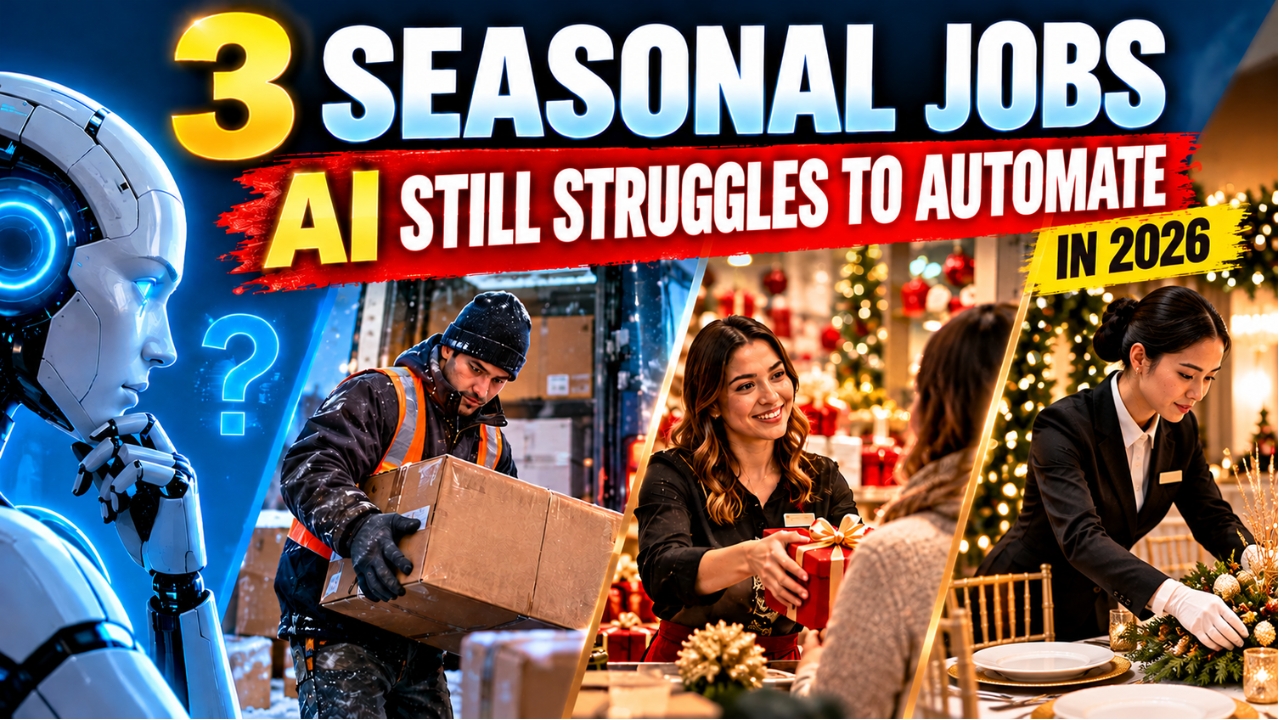
Why Are Seasonal Jobs Still Available as AI Automation Expands?
Artificial intelligence can process customer requests, forecast inventory, and support business operations. Yet the holiday shopping season still requires workers to move packages, assist customers, and coordinate services in physical environments. These responsibilities help explain why some seasonal jobs remain difficult to automate completely.
For U.S. workers seeking temporary employment in November and December 2026, three sectors deserve attention: logistics and delivery, retail customer service, and hospitality and event services. None is immune to automation, but each includes tasks that require physical movement, judgment, communication, or responses to changing circumstances.
The hiring outlook is mixed. On October 7, 2026, UPS announced plans to hire more than 100,000 seasonal employees across hundreds of U.S. locations. Meanwhile, Challenger, Gray & Christmas forecasts approximately 450,000 seasonal retail jobs will be added during the fourth quarter, down from 461,500 in the same quarter of 2025. The retail figure is a forecast, not a final count of actual hires.
1. Warehouse and Delivery Jobs
Warehouse and delivery work remains a major part of holiday logistics. As online orders increase, businesses need to receive shipments, sort packages, move goods, and complete deliveries within tight timeframes.
Typical seasonal positions include:
-
Package handlers and warehouse associates
-
Delivery drivers and driver helpers
-
Stockers and order fillers
-
Shipping and distribution support workers
Why are warehouse and delivery jobs difficult to automate completely?
Automated systems can sort standardized parcels, track inventory, and guide warehouse operations. However, workers may still need to handle irregularly shaped packages, respond to damaged shipments, resolve delivery problems, and operate in changing environments.
Delivery workers also encounter traffic, weather conditions, restricted access, and customer-specific instructions. These situations require more than processing predictable information.
The U.S. Bureau of Labor Statistics projects that e-commerce logistics will support demand for several transportation and material-moving occupations over 2024 to 2034. At the same time, it expects warehouse automation to limit employment growth in the warehousing and storage industry.
For people searching for seasonal warehouse jobs in the USA in 2026, the practical lesson is to look for roles involving physical handling, exception management, and coordination rather than assuming every warehouse position offers the same prospects.
2. Seasonal Retail and Customer Service Jobs
Retailers face a different set of demands during the holiday shopping season. Customers may need help choosing gifts, locating products, comparing options, understanding return policies, or resolving problems with purchases.
Common seasonal retail positions include:
-
Sales associates
-
Gift and product assistants
-
Stockroom associates
-
Returns and customer service representatives
Can AI replace seasonal retail workers?
AI tools can answer routine questions, recommend products, support online shopping, and assist with inventory management. Self-checkout systems can also reduce the need for staff to handle some transactions.
However, in-person retail work can involve complicated returns, product-specific questions, customer concerns, and situations that require an employee to explain available options. Human interaction remains useful when a standard automated response does not resolve the issue.
That does not mean retailers will always hire more seasonal workers. Challenger, Gray & Christmas expects U.S. retailers to add about 450,000 seasonal jobs in the fourth quarter of 2026, reflecting a more restrained hiring outlook than in the previous year.
Applicants considering seasonal retail employment should therefore check local vacancies, shift requirements, and the length of the contract rather than assuming that holiday demand guarantees a job.
3. Hospitality and Event Service Jobs
Hotels, event venues, private parties, and corporate gatherings may require additional staff during busy holiday periods. These workplaces depend on coordination between employees, guests, supervisors, and service teams.
Potential seasonal positions include:
-
Banquet and event service staff
-
Event setup assistants
-
Hotel guest service workers
-
Venue support employees
Why does hospitality still require human interaction?
Digital booking systems can manage reservations, while AI assistants can answer common questions and help coordinate schedules. But an event may involve last-minute changes, unexpected guest requests, room adjustments, or timing problems.
Employees may need to communicate with several teams, respond to changing instructions, and address situations that do not follow a standard process. Physical setup and guest-facing responsibilities also require work in real-world environments.
Automation can support these operations, but its effect varies by employer and job duty. Hospitality workers should not assume that every role is protected from technological change.
For applicants, useful factors to compare include hourly pay, shift timing, physical requirements, transportation, and whether the employer offers work beyond the holiday period.
Comparing the Three Seasonal Job Categories
| Job category | Tasks that can be harder to automate fully | Automation exposure |
|---|---|---|
| Logistics and delivery | Package handling, delivery exceptions, changing road conditions | High automation of selected tasks |
| Retail customer service | Complex returns, in-person assistance, customer concerns | High automation of routine transactions |
| Hospitality and events | Event setup, guest requests, changing service requirements | Varies by venue and responsibility |
These are qualitative comparisons, not formal occupational risk ratings. Automation exposure depends on the employer’s technology, the duties involved, and how the job is organized.
How to Find Seasonal Jobs in the USA in 2026
Workers looking for holiday employment can take several practical steps:
-
Search official employer career pages. Check logistics companies, retailers, hotels, and event venues for current seasonal openings.
-
Use specific job-search phrases. Try “seasonal warehouse jobs near me,” “holiday delivery helper jobs 2026,” “seasonal retail customer service jobs,” or “temporary event staff jobs.”
-
Compare the employment terms. Review hourly pay, shift schedules, contract dates, physical requirements, and eligibility conditions.
-
Check the application details. Confirm the location, application deadline, expected start date, and whether the position is temporary or potentially ongoing.
-
Build relevant skills. Communication, safe package handling, problem-solving, reliability, and familiarity with workplace technology can help applicants meet role requirements.
A seasonal job can provide temporary income and work experience, but hiring is not guaranteed. Applicants should verify each vacancy directly with the employer.
Frequently Asked Questions
1. What seasonal jobs are hardest for AI to automate in 2026?
Some roles involving physical handling, unpredictable environments, and direct human interaction can be harder to automate completely. Examples include certain delivery jobs, retail customer service positions, and hospitality event roles. However, automation can still change the number of workers required and the tasks they perform.
2. Is UPS hiring seasonal workers for the 2026 holiday season?
Yes. UPS announced on October 7, 2026, that it planned to hire more than 100,000 seasonal employees across hundreds of U.S. locations. Applicants should consult the official UPS careers website to verify current vacancies, eligibility requirements, and available locations.
3. Are seasonal retail jobs declining in the United States?
The current forecast points to a decline. Challenger, Gray & Christmas projects approximately 450,000 seasonal retail jobs will be added in Q4 2026, compared with 461,500 in Q4 2025. This is a forecast of employment changes during the quarter, not a count of every job advertised or every worker hired.
4. Can seasonal jobs provide long-term career opportunities?
Some seasonal positions may lead to continued employment, relevant experience, or opportunities to apply for other roles. However, conversion to permanent employment depends on employer requirements, business needs, performance, and available vacancies. Workers should confirm whether an employer offers a path to ongoing employment instead of assuming that a temporary position will become permanent.
The Bottom Line
Seasonal jobs in logistics, retail, and hospitality continue to offer employment opportunities during the 2026 holiday season, but the hiring picture varies by sector. Physical work, problem-solving, and customer interaction can make some tasks difficult to automate completely. At the same time, AI and robotics are changing how employers organize their operations.
The most useful approach is to evaluate the actual duties, employment terms, and current vacancies of each role. No job category is entirely protected from automation, and no seasonal position guarantees continued work.
AI Content Disclosure: This article was created with AI assistance and reviewed and edited for factual accuracy using publicly available sources. Image: AI-generated with ChatGPT for Solution Tales.
General informational disclaimer: This article is for informational purposes only and does not constitute career, employment, financial, or professional advice. Hiring figures may change, and forecasts are not guaranteed outcomes. Verify current vacancies and employment conditions directly with employers.
Sources
-
Challenger, Gray & Christmas, 2026 Holiday Hiring Outlook
-
U.S. Bureau of Labor Statistics, Industry and Occupational Employment Projections, 2024–34